
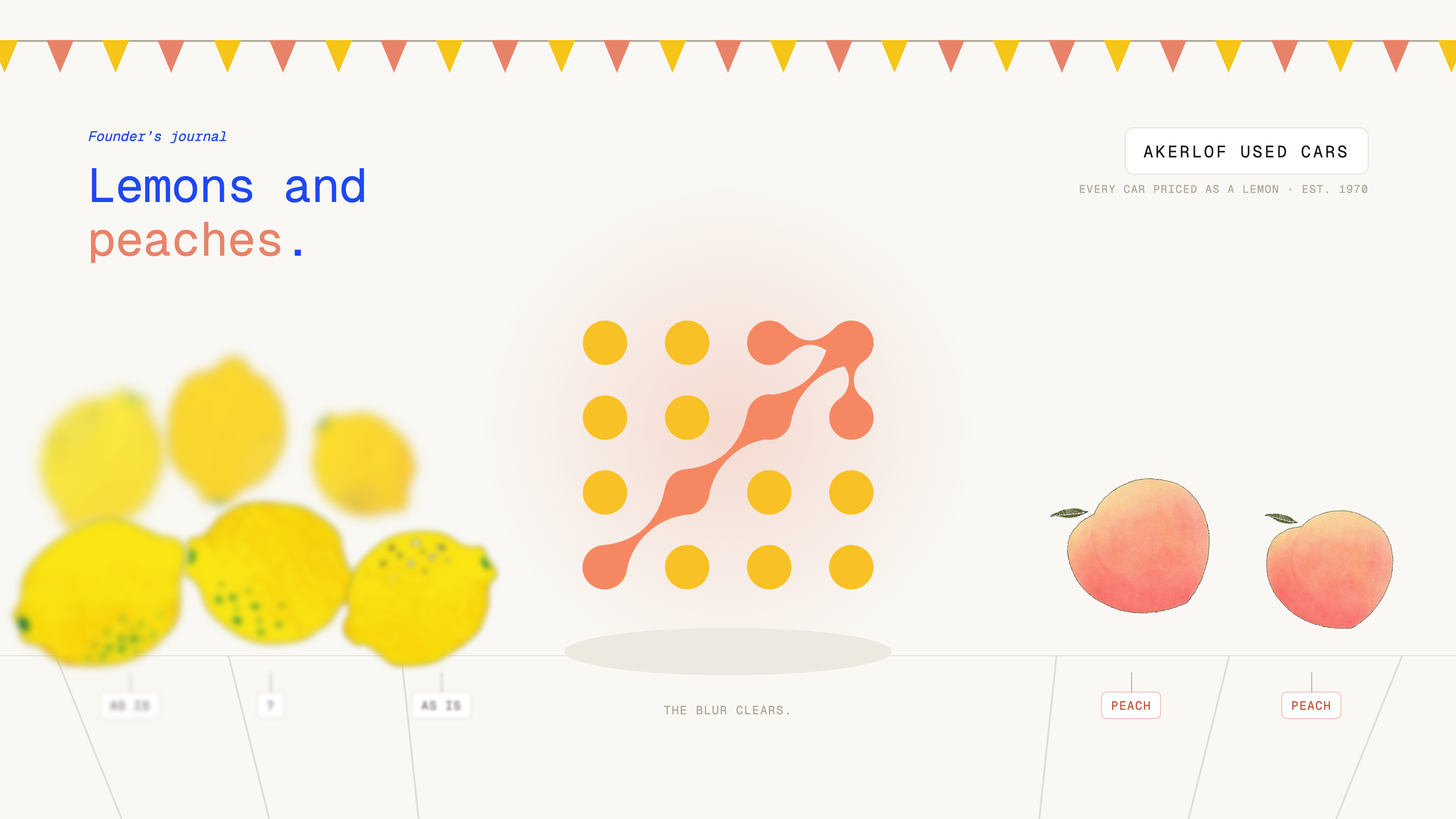
We were on a call about the website, and someone helping us with the redesign asked, almost in passing, where the logo had come from. I think they expected a short answer. A color someone liked, a shape that felt clean, something off a mood board. But that's not actually where the logo came from.
There's a thing Saumya and I do when we're trying to land on something, and the logo came out of it the same way everything else does. She sets up the question and asks what I think, and I just vomit out everything I know — unrestricted, uncontrolled, untidy, usually more than anyone asked for. We record it, mostly so I know afterward what I actually said. Then she sits with it for a while, lets it marinate, and comes back with what she thinks we should do. Then we brainstorm and argue it down to something smaller.
We came at the logo that way too. First a scooter animation, then a fancier version of the same animation, and both times we ended up thoroughly let down by what came out. Eventually we just stepped away, because nothing was really working and staring at it longer wasn't going to fix that.
An hour later Saumya asked me something that sounded almost too simple to be a real question. Why is sales hiring hard? It felt like a strange thing to ask, four months into building a company about exactly that… how could she not know, I thought to myself. But I answered anyway, for about thirty minutes, mostly without stopping. No sales schools that teach the job the way engineering schools teach engineering. No portfolios. No hard, checkable skill the way a whiteboard checks someone in a technical interview. Somewhere around minute twenty-seven I remembered we were recording, and I noticed myself cursing a lot less for the rest of it.
Hmm, she said, forty-five minutes later. That was the whole response. I didn't think much of it at the time. You get used to that, working with her this way an answer that sounds like nothing landing somewhere you can't see yet.
A few days later she told me sales hiring reminded her of a 1970 paper by an economist named George Akerlof, called "The Market for Lemons." I went and read it. Akerlof was writing about used cars. A buyer walking onto a lot can't tell a good car from a bad one just by looking. The seller knows. The buyer doesn't. In America a bad used car is a lemon, and a good one, less often said, is a peach. Because buyers can't tell which is which before they've already paid and driven off, they price every car as if it might be a lemon. Owners of the actual peaches look at that price and decide it's not worth selling into it. So the good cars stay off the market, the ones that do get sold skew lemon, and the whole thing rots a little at a time, not because anyone's being dishonest, just because there's no way to tell the good ones apart from where a buyer is standing.
The sales hiring market is the same shape. This is because a resume can't tell you who can actually sell and who's just good at sounding like they can. A recruiter's pitch can't tell you who actually understands your product and who's running the same search they ran for three other companies last month. Everyone's guessing, and the guessing has a cost, and the cost lands hardest on the people who are actually good at the job, because a great salesperson with a plain resume looks, on paper, exactly like a mediocre one with a polished one. The peaches can't prove they're peaches. So companies hedge, hiring slows down, and it isn't really anyone's fault. It's just what an information gap does to a market, quietly, over time.
What we were trying to build, underneath everything else, was a way to close that gap a little. We will never claim to find perfect people, hiring is so personal so ‘perfect doesnt exist. We just want to build something for both sides, the company and the candidate, to actually see each other clearly before they commit to anything. Signal instead of noise, if you squint at it long enough.
That's where the actual shape of the mark came from. A cluster of forms with no edges to them, blurred into each other, the way a stack of resumes looks the same from far enough away. And then, moving across it, that cluster resolves funnels down into a handful of shapes you can tell apart. Clear edges. Distinct. You can't say in advance which shapes those will turn out to be. The mark isn't picking winners. It's just describing what happens when the blur clears.
I don't think whoever asked the question expected any of that from something about where a logo came from. I'm not sure I would have either, if Saumya hadn't been the one who actually heard it in what I said and gone looking for the word for it. I still don't fully know how she got from thirty minutes of me half-cursing about sales schools to a fifty-year-old paper about used cars. I've asked her a couple of times since. She just says it reminded her of it. That's usually as far as the explanation goes.